
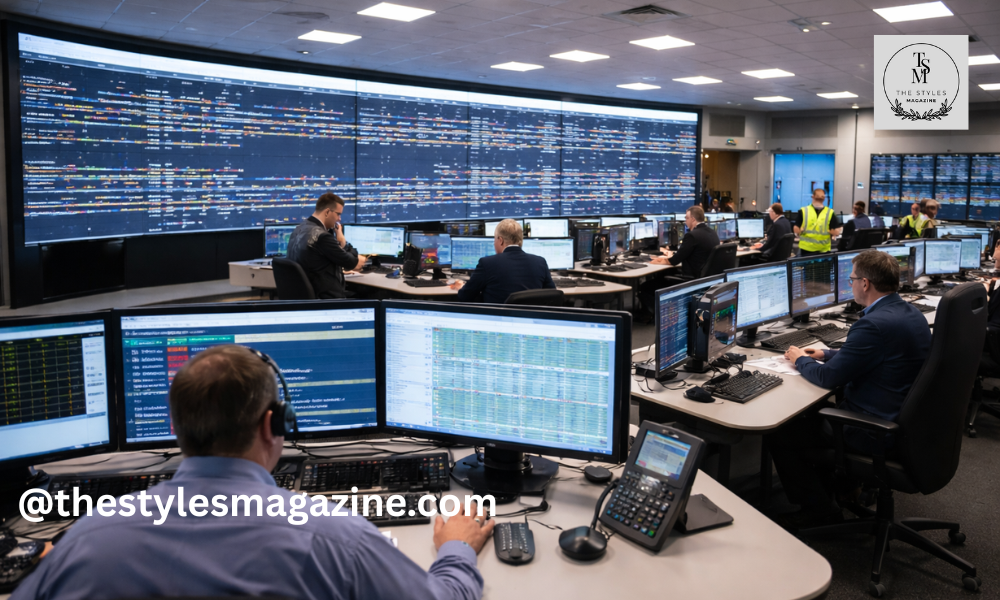
A rail operating centre (often shortened to ROC) is a modern control hub where teams monitor and manage train movements across a large area. Think of it as the place where the railway’s “live traffic” is watched, decisions are made, and disruptions are handled in real time.
People search this topic for different reasons. Some want to understand how trains are controlled. Others are researching signalling, railway modernisation, or careers like signaller and rail controller. This guide explains the rail operating centre clearly, step by step, so you finish with a complete picture.
What Is A Rail Operating Centre (ROC)?
A rail operating centre is a purpose-built facility that brings key railway control functions under one roof. Inside, you typically find signallers (who set routes and protect train movements), controllers (who manage service performance and disruption), and support teams who coordinate maintenance, electrical systems, and customer information.
In the UK, “rail operating centre” most commonly refers to a Network Rail programme where many older signalling locations are gradually being replaced by fewer, larger centres. In other countries, the name might vary, but the idea is similar: centralise control to improve coordination and consistency.
A good way to remember it is this: the railway is spread out across hundreds of miles, but the decision-making can be concentrated so teams can see the wider picture and act faster.
Why Railways Moved From Many Signal Boxes To Fewer Operating Centres
For decades, railways were controlled from lots of separate signal boxes and control points. That worked well in its time, but it also created boundaries. When a train crossed from one area to another, coordination depended heavily on calls, handovers, and local knowledge. During disruption, small delays could turn into big ones because decisions were made in separate places, sometimes with different priorities.
A rail operating centre improves this by making collaboration easier. When signallers and controllers sit closer together, decisions can be made with fewer steps. Instead of chasing updates from multiple locations, teams can share the same live information and agree a plan quickly.
There’s also a staffing reality. Running many small sites can be harder over time, especially when skilled roles require training, rest rules, and 24/7 coverage. Consolidation can help standardise processes and training, and make it easier to support people on shift.
Practical tip from real-world operations thinking: In most transport control rooms, speed matters less than clarity. A few clear decisions, made early, often beat a long chain of “maybe” calls.
What’s Inside A Rail Operating Centre: People, Rooms, And Systems
A rail operating centre is not just a room full of screens. It’s a structured workplace designed for safe, consistent decision-making.
Key roles you’ll usually find
- Signallers: They control signals and routes, ensuring trains move safely and conflicts are prevented.
- Route or service controllers: They focus on performance, disruption plans, and keeping services moving when things go wrong.
- Electrical control and asset teams: In many networks, power supply and key infrastructure status is monitored alongside traffic.
- Incident and liaison staff: These roles help coordinate with stations, train operators, emergency services, and passenger information teams.
Typical spaces and layout
Most centres include:
- A main operations floor with workstations set up for long shifts
- Quiet rooms for breaks and handovers
- Meeting spaces for incident briefings
- Training rooms (often including simulation tools for safe practice)
The layout is usually designed to reduce noise and distraction, because a rail control decision can impact thousands of passengers. You’ll also see very formal shift handovers. A strong handover is one of the best safety tools in any control environment.
How The Rail Operating Centre Manages The Railway Day-to-day
On a “normal” day, the work is steady, detailed, and methodical. The goal is simple: keep trains moving safely and on time, while balancing maintenance needs and changing conditions.
1) Monitoring The Network
Operators watch live train positions, track status, and planned work. They look for small warning signs early, such as trains starting to bunch up behind a late service, or a platform change causing knock-on delays.
2) Setting Routes And Protecting Movements
Signallers set train routes through junctions, stations, and busy sections. This includes managing conflicting moves, prioritising certain services, and keeping safe separation between trains.
3) Managing Planned Work
Railways need maintenance, upgrades, and inspections. The operations team coordinates access windows so work can happen safely without creating avoidable disruption. This planning work is often “invisible” to passengers, but it’s a daily balancing act.
4) Helping The Timetable Recover
Not every delay is dramatic. A late-running train, a short platform hold, or a minor technical issue can slowly build pressure across the system. Good control work often means applying small corrections early, so the whole day doesn’t slide off track.
Helpful perspective: Many people think rail control is mostly about emergencies. In reality, a big part of the job is preventing small issues from becoming emergencies.
What Happens During Disruption: The Rail Operating Centre In “Incident Mode”
Disruption is where the rail operating centre really earns its value. When something goes wrong, the centre shifts into a faster, more coordinated approach.
Common disruption triggers
- Signal or points failures
- Fallen trees, flooding, or high winds
- A trespass incident
- A train fault blocking a critical line
- Emergency response on or near the railway
What changes in incident mode
- Faster coordination: Controllers and signallers align quickly on the safest, simplest plan.
- Service regulation: Trains may be held, turned short, or re-ordered to reduce congestion.
- Passenger information: The message has to match the operational plan. Conflicting updates create confusion and crowding.
- Recovery planning: The goal is not just to “get through the moment” but to restore a stable timetable.
A well-run control centre avoids over-complicated plans when the network is stressed. In disruption, the best plan is usually the one that is clear, safe, and easy to execute repeatedly.
Expert-style tip: If you’re unsure which decision is best, choose the one that reduces the number of moving parts. Complexity is the enemy during incidents.
Key Technology Behind A Rail Operating Centre (without The Heavy Jargon)
A rail operating centre relies on software and control systems that help teams see what’s happening and act safely. You don’t need to be an engineer to understand the basics.
Core tools you’ll hear about
- Signalling control interfaces: These allow routes and signals to be set safely using defined rules.
- Train describers or tracking systems: These show where trains are and what service they are running.
- Traffic management support: In some networks, tools help predict conflicts and suggest better sequencing, especially in busy areas.
- Remote condition monitoring: Asset data can warn about equipment health before it fails.
It’s important to understand one thing: technology supports decisions, but it doesn’t replace responsibility. The centre’s strength comes from trained people using reliable tools with disciplined processes.
Benefits Of A Rail Operating Centre: What Improves And Why
A rail operating centre is usually built to deliver practical, measurable improvements. When implemented well, it can help in several areas.
Better Network-wide Coordination
When teams can see a wider area, they can manage knock-on delays more effectively. A problem in one place often affects many other places. Central visibility helps controllers avoid “fixing one area while breaking another”.
More Consistent Operating Standards
Centralisation often leads to more standard processes, clearer incident playbooks, and better training consistency. That matters in a safety-critical environment where small differences can cause confusion.
Faster Disruption Recovery
Even when you can’t prevent a problem, you can reduce its impact. Good control decisions, made quickly, can keep key routes moving and prevent gridlock.
Better Support For Modern Signalling Upgrades
As networks modernise, control locations need to integrate new systems and new ways of working. Central sites are typically designed to handle these changes more easily than many small, older buildings.
Challenges And Risks: What Operators Must Get Right
A rail operating centre is not automatically “better” just because it is new. There are real challenges that must be handled carefully.
Risk 1: Single Point Of Failure
If a large centre controls a big area, any major disruption to that centre can affect more of the network. This is why contingency planning and resilience measures are critical.
Risk 2: Workload And Human Factors
Consolidation can increase workload per workstation if not designed properly. Fatigue, distraction, and poor ergonomics can hurt performance. Good centres invest in workstation design, clear alarms, and strong staffing plans.
Risk 3: Transition Periods
The changeover from old control points to a new rail operating centre can be complex. During migration, staff may need to learn new systems while still supporting day-to-day operations. Careful phasing and realistic timelines matter.
Risk 4: Over-Reliance On Tools
When everything is screen-based, teams can be tempted to trust the system too much. Good training emphasises cross-checking, clear communication, and disciplined handovers.
Practical advice: A modern control room needs modern resilience. That means backup power, redundant communications, tested fallback plans, and people who have practised those plans, not just read them.
Rail Operating Centre Vs Signalling Centre: Are They The Same Thing?
People often mix these terms, and it’s understandable.
- A signalling centre mainly focuses on controlling signals and routes.
- A rail operating centre typically includes signalling plus broader operational control functions, bringing more teams together.
In practice, naming varies by country and operator. Some organisations use “operations control centre”, “network control”, or “integrated control centre”. The important point is the function: centralised control that coordinates train movement, performance, and incident response.
Careers And Skills: Who Works In A Rail Operating Centre?
If you’re interested in working in a rail operating centre, it helps to understand what employers actually look for.
Skills That Matter In Real Operations
- Calm decision-making: You’ll handle pressure without rushing.
- Clear communication: Short, accurate messages beat long explanations.
- Rule discipline: Safety depends on consistent procedures.
- Situational awareness: You must see how one decision affects the wider network.
- Teamworking: Control work is rarely solo. You rely on handovers and shared plans.
What The Work Feels Like
Shifts can be quiet and steady, then suddenly intense. A normal morning might be routine monitoring, then a single equipment failure creates a chain reaction of platform changes, train holds, and passenger updates. The best operators stay calm, follow process, and keep decisions simple.
If you’re building a career plan, focus on roles that prove you can work responsibly in a safety-critical environment. Many rail organisations value experience in operations, dispatch, station control, or technical support.
Conclusion
A rail operating centre is a modern way to run a railway more consistently, with better coordination and stronger real-time decision-making. By bringing signalling and operational control together, it helps railways respond faster to disruption, support modern upgrades, and manage complex networks more effectively.
At the same time, centralisation must be done carefully. Resilience, workload management, and well-practised contingency planning are not “nice extras”. They are essential for safe, reliable operations.
If you’re researching rail operating centres for learning, planning, or career reasons, the best mindset is this: a rail operating centre is not just a building. It’s a system of people, tools, and processes designed to keep the railway safe and moving, even when the day doesn’t go to plan.
FAQs
Does A Rail Operating Centre Control Every Railway?
No. The term is strongly associated with certain national programmes, especially in Great Britain, but not every railway uses the same model or name.
Can One Centre Really Control A Huge Area Safely?
Yes, but only with the right design: trained staff, safe signalling principles, strong supervision, and tested contingency plans.
Why Do Passengers Still Experience Delays If Control Centres Exist?
Because many causes of disruption are physical or external: equipment failures, weather, incidents, and capacity limits. A rail operating centre helps manage the impact, but it can’t remove every constraint.
Is A Rail Operating Centre Mostly Technology?
Technology is important, but people and process are equally important. Good control is about disciplined decisions, strong teamwork, and clear communication.
Does this article help you? Explore our website The Styles Magazine to find more helpful and fun stories that could help you.
Disclaimer: This article is for general informational and educational purposes only. It explains the concept of a rail operating centre in a simple way and may not reflect every railway network’s exact procedures, terms, or control systems. Rail operations are safety-critical and rules vary by country and operator, so always follow the official guidance, training, and policies provided by your local railway authority or employer. The information here should not be treated as professional engineering, legal, or operational instruction for live railway environments.
