
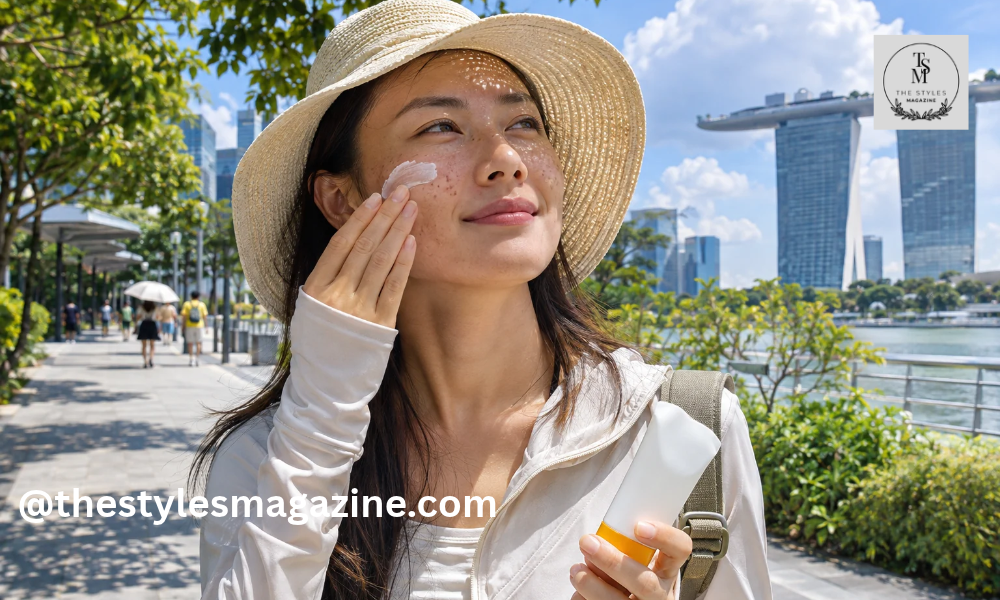
There is a quiet luxury in a four-season climate: the winter months grant your skin a natural reprieve. The sun softens, the air cools, and pigmentation has a chance to fade. Singapore offers no such seasonal mercy.
Here, the sun sits high and unwavering for most of the year, quietly compounding its effects whether you are lounging at Sentosa or working behind a desk in the CBD. If you have noticed uneven tone, stubborn dark spots, or a lingering dullness, you are not imagining things. You are simply experiencing the equatorial reality.
While a high-SPF sunscreen is your daily shield, persistent pigmentation often requires a more strategic approach. For many, this means pairing disciplined sun habits with targeted medical solutions, such as laser pigmentation treatment. But before we explore advanced interventions, let’s unpack the science behind Singapore’s sun and why your skin reacts the way it does.
Decoding Singapore’s UV Reality
The Numbers Behind the Glow
The UV Index is an international standard developed by the World Health Organization and allied global bodies. According to the National Environment Agency (NEA), it ranges from 0 to 11+, categorised from low to extreme. Readings of 8 to 10 are considered “very high,” while 11 and above are classified as “extreme.” At both levels, the NEA strongly advises enhanced protection against sun damage.
In Singapore, this data isn’t theoretical. The UV Index is measured live at the Changi Meteorological Station and reported regularly throughout the day. The NEA notes that it is common for readings to hit these very high and extreme levels between 11am and 3pm on days with minimal cloud cover.
The Equatorial Challenge
Because Singapore sits close to the equator, sunlight reaches the ground at a steeper angle. It passes through less atmosphere, allowing more UV radiation to penetrate the surface. This results in far less seasonal variation than you would experience in temperate climates.
While not every single day hits extreme levels, NEA data indicates that daily maximum readings average between six and nine year-round. UV levels also tend to peak during the drier months, such as February and March, when cloud cover is sparse. Ultimately, a strong reading on a clear day can occur in any month. For your skin, there is no true “off-season.”
The Myth of the “Safe” Day
Your Skin Has a Long Memory
When UV radiation strikes the skin, specialised cells produce more melanin as a natural, protective response. The complication arises when this trigger is pulled constantly. Over time, pigment clusters unevenly, manifesting as sun spots, patchy tone, or a persistent dullness that cosmetics can only temporarily mask.
Most of us do not register “sun exposure” as a daily lifestyle factor, associating it instead with beach holidays or weekend hikes. In reality, the most significant exposure in Singapore is incidental. It’s the brief walk from the MRT station to your office building. It’s a lunchtime queue at a hawker centre, squarely within the 11am to 3pm peak window. It’s sitting beside a sunlit window on the bus or at your desk.
These moments rarely feel like sunbathing, but it is this daily repetition—the micro-dosing of UV radiation—that the skin registers and compounds over time.
The Cloud Cover Illusion
A grey sky can create a false sense of security. However, the NEA notes that it takes thick, dense cloud cover to prevent readings from reaching very high or extreme levels around noon. Thin or patchy clouds offer little to no filtration. If your skin will be exposed to the outdoors, sunscreen remains non-negotiable, regardless of the sky’s appearance.
Not All Dark Spots Are Created Equal
Pigmentation is not a monolith. Several distinct concerns frequently present themselves in our climate, and they do not all respond to the same treatments:
- Sun spots: Flat, darker patches that typically appear on areas receiving the most direct sun, such as the cheeks, nose, and forehead.
- Uneven skin tone: A blotchy or dull complexion that develops gradually over time.
- Post-inflammatory hyperpigmentation (PIH): Dark marks that linger long after a breakout or minor skin injury has healed.
- Melasma: Larger, symmetrical patches of darkening influenced by both hormonal fluctuations and sun exposure.
Distinguishing between these is critical, as a physician will recommend entirely different protocols for each. Relying on a mirror or a friend’s anecdotal experience is rarely a reliable diagnostic strategy.
Building Your Equatorial Defense System
Whatever advanced treatments you pursue, these foundational habits dictate your long-term results. Think of them not as chores, but as lifestyle upgrades:
- Make SPF 30+ your non-negotiable final step. A broad-spectrum formula should be applied every morning, even if your calendar is strictly indoor.
- Reapply strategically. A single morning application will not last until evening, especially in our humid weather. Reapplying around midday is a prudent ritual if you are stepping out for lunch.
- Leverage shade and accessories. A wide-brimmed hat, UV-blocking sunglasses, and a trusty umbrella significantly reduce direct exposure.
- Schedule around the peak. Where possible, plan outdoor errands, workouts, or school pick-ups before 11am or after 3pm.
- Monitor the UV reading. A quick check of the NEA’s live UV Index before heading out can inform exactly how much protection you need that day.
- Treat your skin gently. Harsh scrubbing can induce inflammation, which may ironically worsen pigmentation. Keep your routine simple, consistent, and soothing.
A Note for Newcomers and Frequent Travellers
If you have recently relocated to Singapore or are embarking on an extended stay, it is easy to underestimate the equatorial sun. Skin accustomed to milder climates may react more swiftly than anticipated. Treat your first few months as an acclimation phase: apply broad-spectrum sunscreen daily from the outset, and allow your skin time to adapt rather than waiting for visible marks to emerge.
When Daily Defense Isn’t Enough
Sun protection preserves the skin you have, but it cannot reverse what has already accumulated. If a patch is darkening, spreading, changing shape, or simply refusing to fade, it warrants professional evaluation.
An accurate assessment is the critical first step. A physician must identify the specific type of pigmentation before recommending a course of action, and any new or changing spot should be evaluated to rule out medical concerns.
Once the underlying cause is established, your doctor may discuss targeted interventions. For certain types of pigmentation, advanced options such as laser skin rejuvenation are frequently utilized to address uneven tone and dullness with minimal downtime. Suitability depends on your skin type, the specific nature of the pigmentation, and your medical history, with the number of sessions varying per individual.
A typical consultation is a collaborative process that covers:
- A detailed, professional analysis of your skin and pigmentation patterns.
- A thorough review of your medical history, current medications, and past skin reactions.
- A transparent discussion of realistic expectations and treatment timeframes.
- Comprehensive aftercare guidance, emphasising how to protect treated skin from the sun.
Whichever route you choose, professional treatment and daily sun protection are symbiotic. Without consistent sunscreen use, even the most meticulously planned treatment will struggle to maintain its results in Singapore’s climate.
The Equatorial Takeaway
- Singapore’s UV index does not switch off for a “winter.” Very high and extreme readings are common on clear days, particularly between 11am and 3pm.
- Incidental exposure is the silent driver of pigmentation. Daily habits are far more impactful than occasional beach-day precautions.
- Sunscreen, shade, and strategic timing form the non-negotiable foundation of any skincare routine here.
- Different pigmentation requires distinct approaches. Always seek a professional assessment before attempting to self-treat.
- Medical interventions are highly effective for stubborn concerns, but they achieve their best, longest-lasting results when paired with rigorous sun protection.
Living on the equator offers countless perks—from vibrant food culture to year-round summer. With a little daily diligence, your skin can enjoy them, too.
Does this article help you? Explore our website The Styles Magazine to find more helpful and fun stories that could help you.
