

Journaling looks simple from the outside: a notebook, a pen, and a few quiet minutes. Yet many people who want to start never do, because they worry about doing it wrong. The truth is gentler than that. Journaling for beginners needs no special talent, no beautiful handwriting, and no perfect routine. It needs only a willingness to put honest thoughts on paper, regularly, in your own words.
This guide explains how to start journaling in a way that fits real life. You will learn how to choose between paper and digital, what supplies you truly need, how to write a first entry without pressure, and how to build a daily journaling habit that survives busy weeks. A journal is a private place for thinking, and the best way to keep one is the way you will actually use.
How to start journaling means choosing a notebook or app, setting aside a few quiet minutes, and writing honestly about your day and thoughts without rules; thestylesmagazine.com only provides information about starting journaling, nothing else.
Quick Guide
| Step | What to do | Time | Why it helps |
|---|---|---|---|
| Choose | Notebook or app, pen that works | 10 minutes | One ready place to write |
| Set a time | Same time most days | 2 minutes | Routine removes daily deciding |
| Start small | Three to five lines only | 5 minutes | Small starts are easy to keep |
| Write honestly | Thoughts, not performance | 5 minutes | Honesty is where the value lies |
| Close simply | One line about tomorrow | 1 minute | A gentle ending, easy to repeat |
Step-by-Step Guide
- Choose one notebook or one app, and keep it in the place where you will write each day.
- Pick a regular time, such as after breakfast or before bed, and protect ten minutes for it.
- Open to a fresh page, write the date, and begin with one simple sentence about today.
- Write for five to ten minutes, without editing, correcting, or judging what appears.
- Stop at a natural point, close the journal, and return tomorrow at the same time.
What Journaling Is, and What It Is Not
Journaling is the regular practice of writing down thoughts, feelings, experiences, and plans in a private place. The form is flexible, and that flexibility is part of its value. A journal is not a diary in the narrow sense of a daily record, though it can include one. Journaling vs diary writing is a useful distinction: a diary usually records what happened, while a journal also explores what it meant, how it felt, and what might come next.
Journaling is also not a test, a performance, or a product to show others. Spelling, grammar, and neatness do not matter, and no one else needs to read a word of it. It is not therapy, and it does not replace professional help for serious difficulties. The only real requirement is honesty with yourself. Write what is true, in plain words, and let the practice do its work quietly over time.
Why Journaling Helps: Clarity, Calm, and Memory
People keep journals for many reasons, and most of them come down to clarity. Writing forces thoughts into words, and words reveal what matters. A worry that feels huge in the mind often looks smaller and more manageable on paper, where it can be examined, questioned, and planned around. Journaling for mental clarity works in this simple way: it moves thoughts out of the head and onto the page, where they can be seen whole instead of circling endlessly.
Journaling also helps memory and calm. Days blur together when nothing is recorded, but a few lines each evening preserve details that would otherwise fade: a conversation, a decision, a small pleasure. That knowledge is useful, and it grows naturally from the habit. No special method is needed. Regular, honest writing is enough to bring these benefits, a little at a time.

Paper or Digital: Choosing How You Will Write
The paper-or-digital choice matters less than most beginners expect, because both can work well. Paper suits people who enjoy the physical act of writing, who want a break from screens, or who like keeping a notebook beside the bed. Handwriting is slower, which some people find helps them think, and a paper journal needs no battery, password, or app.
Digital journaling suits people who type quickly, travel often, or want to search past entries easily. A notes app, a document, or a dedicated journal app can all work, and typing can feel easier on days when handwriting feels slow. Whichever you choose, pick one method and use it for a month before switching. Changing tools too often becomes a way of avoiding the writing itself, and consistency matters more than the medium.
Supplies: Keep It Simple at First
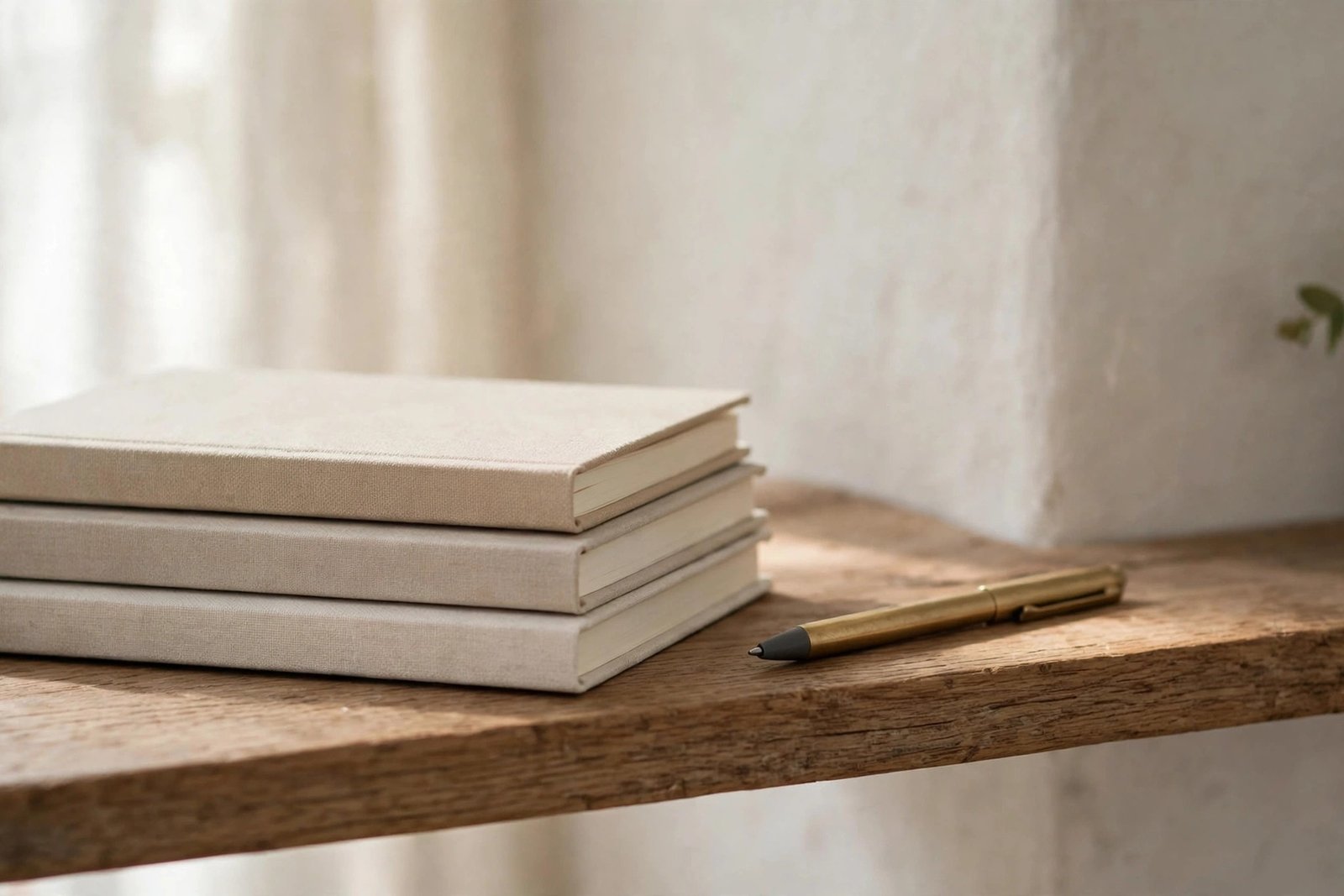
Journaling supplies for beginners should be few, cheap, and ready to use. Start with one notebook you like holding, one pen that does not skip, and a quiet place to keep them. That is genuinely enough. A notebook need not be expensive or beautiful, and an ordinary exercise book works perfectly well. Test a few pens, choose one you enjoy, and keep a spare nearby.
Resist the urge to buy a full set of supplies before writing a single page. Start plain, write for a few weeks, and then add one thing at a time if you wish. If a supply genuinely helps, such as a small notebook that fits in a bag, add it. If it only looks good, leave it. The journal itself, not the supplies around it, is the point.
Finding a Time and Place That Works
A journaling habit needs a time and a place that repeat most days. The time matters more than the length: five minutes at the same hour beats thirty minutes at a different hour each day. Many people write in the morning, when the mind is fresh and the day has not yet made demands. Others prefer the evening, when the day can be reviewed and set aside.
The place should be comfortable, quiet, and free from interruption where possible. A kitchen table, a favourite chair, or a corner of the bedroom can all work. Keep the journal there, open or visible, so starting takes no effort. A simple journaling routine depends on this pairing of time and place. When the moment arrives and the journal is waiting, beginning is easy, and easy beginnings are what keep habits alive.

Your First Entry: How to Begin Without Pressure
The first entry is often the hardest, because a blank page can feel like it demands something important. It does not. A good first entry is short, plain, and honest. Write the date, then one sentence about today: what happened, how you feel, or what is on your mind. Follow it with two or three more sentences, in any order, about anything that comes to mind. There is no need for an introduction, a conclusion, or a clever opening line. The page only needs to be filled, not impressed.
If words still will not come, use a simple structure for the first week. Write three lines: one thing that happened today, one thing you feel, and one thing you hope for tomorrow. That is a complete entry, and it takes about five minutes. Spelling and grammar can be ignored entirely. The first entry is not a performance. It is a door opening, and a few plain sentences are enough to open it.
Building a Daily Journaling Habit
A daily journaling habit is built the way any habit is built: small, regular, and tied to something that already happens. Link journaling to an existing moment, such as after breakfast, after brushing your teeth, or just before reading in bed. This anchor reminds you without an alarm or an app, and the sequence soon runs on its own. Keep the session short at first, five to ten minutes, and protect it for two weeks before judging whether it works.
Tracking can help in the early weeks. A tick on a calendar for each day you write shows the pattern growing, and a row of ticks is encouraging. If you miss a day, return the next day without drama or doubling up. Missing once is normal life, and the habit is not broken by a single gap. Over a month, the habit begins to feel like a normal part of the day, and the pages begin to add up.
What to Write About Each Day
Beginners often ask what to write about, and the honest answer is almost anything. Write about the day as it happened, a decision you are facing, a conversation that stayed with you, or a feeling you cannot quite name. Write about plans, worries, hopes, and small observations: the weather, a meal, a kindness, a frustration. Ordinary material is the best material, because ordinary days are most of life, and understanding them is the point of the practice.
Variety can keep the habit fresh without adding rules. One day, write a list of three good moments. Another day, describe a problem in detail and list two possible next steps. Another day, write about something you are grateful for, or something you would like to learn. A morning journaling practice often suits plans and intentions, while evening writing suits review and release.

Honesty, Privacy, and Writing for Yourself
A journal works only if it is private and honest. Write for yourself alone, in words you would use in your own thoughts, without imagining a reader. If you soften the truth for an imaginary audience, the journal loses its value as a place to think clearly. Honesty does not mean harshness. It means writing what is actually felt and thought, including uncertainty, mistakes, and hopes that feel fragile.
Privacy needs practical care. Keep a paper journal somewhere safe and private, and do not leave it open where others will read it. If you write digitally, use a password or a locked app, and keep backups if the entries matter to you. Tell people close to you, briefly, that your journal is private, so expectations are clear. A journal that feels truly private is a journal you will use honestly, and honesty is the whole point of the practice.
Journaling for Stress, Gratitude, and Goals
Journaling can support calmer days when it is used as a place to set thoughts down rather than carry them. Writing worries onto paper often reduces their urgency, because they are no longer circling unexamined in the mind. A useful evening pattern is to name one worry, write what is actually known about it, and note one small step that could help.
Gratitude and goals benefit from the same simple approach. A short nightly list of two or three good things, however small, trains attention towards what went well. Goals become clearer when written down with a date and a next step, rather than held as vague intentions. Review these entries once a week, briefly, and notice what repeats. The review is where journaling turns into learning: patterns of stress, sources of pleasure, and steps that actually helped all become visible on the page, in your own words.
When You Miss Days or Face a Blank Page
Every journal keeper misses days, and every keeper faces blank pages. Neither is a reason to stop. A missed day is simply a day without an entry, and the next day offers a fresh page. Do not try to catch up by writing several days at once, and do not apologise to the journal. Start again with today, in a few lines, and the habit resumes. The people who keep journals for years are not those who never miss. They are those who return quickly, without guilt, again and again.
A blank page usually means tiredness, busyness, or a topic that feels too large to start. Shrink the task: write one sentence, or one list of three words, or copy out a sentence that describes the day. If a topic feels too difficult, write around it first, in general terms, and return later. The page does not demand a complete answer. It only asks for a beginning, and a small beginning is always enough.

Reviewing Your Journal and Keeping It Going
Reviewing a journal turns daily writing into understanding. Once a week or once a month, read back through recent entries with a pencil in hand, and note anything that repeats: a worry, a pleasure, a decision, a pattern. Simply notice what the entries say about your days, and write a short summary of what you learned. This review can take ten minutes, and it often reveals more than the daily writing itself, because patterns are easier to see at a distance.
How to keep a journal going for years comes down to a few practical habits. Date every entry, so reviews make sense later. Keep finished journals together, in order, and label them by date. Replace a full notebook promptly, so there is never a gap while you search for a new one. Most importantly, let the practice change with your life. The habit that adapts is the habit that lasts, and a journal kept for years becomes a quiet record of a life, written one honest page at a time.
FAQs
How long should a journal entry be?
Five to ten minutes, or three to five lines, is enough to begin. Short entries done daily build the habit far better than long entries written rarely, and you can always write more.
Is it better to journal in the morning or evening?
Both work well, so try each for a week and keep the easier one. Mornings suit plans and intentions, while evenings suit review, release, and noting what the day held.
What should I write about if I have no ideas?
Start with three lines: one thing that happened, one thing you feel, and one thing you hope for tomorrow. Ordinary days provide plenty of material, and starting usually brings more words.
Do I need an expensive notebook to start journaling?
No, any notebook and a pen that writes smoothly are enough. Start plain and cheap, write for a few weeks, and add nicer supplies later only if they genuinely help you write.
What if I miss several days of journaling?
Return the next day with a short entry about today, without catching up or apologising. A gap does not break the habit, and returning quickly and kindly is what keeps it going.
Conclusion
Starting a journal is simpler than it looks: choose one notebook or app, pick a regular time and place, and write a few honest lines each day. Keep supplies simple, keep entries short, and let the habit grow slowly, without judging the writing or aiming for perfection. The first entry is the only hard one, and it needs only a date and one true sentence. Choose your notebook tonight, set it where you will see it, and write your first few lines tomorrow. Your future self will be glad you began.
Disclaimer: This article is provided for general information only and is not professional advice. It does not involve guest posting, paid promotion, or advertising, and thestylesmagazine.com does not sell or endorse any product mentioned. Results vary from person to person, so consider speaking with a qualified professional about stress, health, or other personal concerns before making major changes.
Does this article help you? Explore our website The Styles Magazine to find more helpful and fun stories that could help you.
Where to Buy KangerTech T3S Coils In Oakland California: Your Guide To Reliable Vaping Supplies
